
Driving With Hearing Loss
Hearing is only one part of situational awareness, and many people with hearing loss drive safely every day. However, driving with hearing loss requires careful consideration and proactive safety habits. If you’re deaf or hard of hearing, good safety planning can help you confidently enjoy the independence that driving brings.
Home | Driving With Hearing Loss
Can You Legally Drive With Hearing Loss? Debunking the Myths
Under the Americans with Disabilities Act (ADA) government agencies must treat disabled individuals in a nondiscriminatory manner. In practice, this means that state licensing agencies must evaluate each person based on their ability to drive safely, rather than the presence of a medical condition. Safe driving is primarily a visual and cognitive task, so being deaf or hard of hearing alone is not typically a valid reason to deny someone a license.
States may still apply reasonable restrictions before issuing a license if a medical condition could affect an individual’s driving ability. For example, states may require applicants with hearing loss to undergo a medical review. This may involve presenting medical documentation demonstrating that they can operate a vehicle safely with or without adaptive equipment.
Safety and Prevalence of Driving While Deaf
Hearing loss is more common than many people might think. Approximately 15% of American adults have some degree of hearing difficulty, and 13% have hearing loss in both ears. Overall, 28.8 million U.S. adults—about 11% of the nation’s adult population—could benefit from using hearing aids.
Significant hearing difficulty becomes more common with age. Around 5% of individuals ages 45-54 and 10% ages 55-64 have disabling hearing loss. The rate increases to 22% for adults ages 65-74 and 55% for those 75 and older.
Many people in this population are capable of being safe drivers. A review by the Federal Motor Carrier Safety Administration found no evidence that people with hearing loss have a higher risk of motor vehicle crashes compared to hearing drivers.
Research from the AAA Foundation for Traffic Safety found that older adults with hearing impairment were less likely to drive at night, on highways, or in heavy traffic. While this suggests a reduced confidence in challenging driving situations, it doesn’t necessarily mean they’re unsafe drivers. Many people with hearing loss continue to drive safely by self-regulating their driving habits and choosing conditions that feel manageable.
The Science of Compensation: How Other Senses Adapt
The human brain is excellent at adapting to an impaired sense. When hearing ability is limited, the brain compensates by strengthening other senses. This is known as cross-modal plasticity.
In individuals who are deaf or hard of hearing, non-hearing senses may step in to provide the environmental awareness that sound would usually offer. Research supports this idea. In one study, deaf participants rated their remaining senses—such as sight, touch, and smell—as stronger than those of hearing individuals.
People with hearing loss have superior peripheral vision and faster visual reaction times. For example, deaf drivers may “hear” sirens by feeling the vibrations of the sound waves hitting the steering wheel. These heightened visual and spatial senses naturally support defensive driving habits.
Basic Safety Tips for Driving While Hard of Hearing
While hearing loss doesn’t automatically prevent safe driving, it does require additional precautions. Here are some safety tips to minimize your accident risk as a hard-of-hearing driver:
- Keep your vision sharp. Schedule regular eye exams and wear corrective lenses if needed. This allows your vision to better compensate for your hearing impairment.
- Work with an audiologist. If your doctor recommends a hearing aid, consider wearing it while driving, even if you don’t use it in other settings. A properly fitted device can help you pick up important sounds such as sirens or horns. Schedule regular checkups with the audiologist to ensure your hearing aid continues to work at its best.
- Limit distractions. Reduce background noise from phones, music, or passengers. A quiet environment makes it easier to detect subtle vibrations and visual cues.
- Plan ahead. Review your route before leaving and confirm that you’re comfortable with the driving conditions.
Tools and Technology That Enhance Safety and Communication for Deaf Drivers
Modern technology offers valuable support for drivers who are deaf or hard of hearing. For example, some cars feature devices that flash or vibrate when sensors detect sirens, horns, or other urgent sounds.
Advanced Driver Assistance Systems also enhance safety through features such as blind spot monitoring, lane departure warnings, and collision avoidance. Wide-angle mirrors and rearview cameras can enhance rear and side visibility, compensating for some of the environmental cues that sound would typically provide.
Additionally, many hearing aids and cochlear implants can be connected to GPS devices or smartphones via Bluetooth. This allows directions to be fed directly into the hearing device, helping you navigate while keeping your eyes on the road.
Communication tools, such as live transcription apps or pre-written visor cards, can ease interactions with law enforcement. These tools can help you quickly explain that you are deaf and provide a means of communication.
Licensing and Commercial Driving Requirements
People with hearing loss generally follow a similar process for obtaining a driver’s license as individuals with normal hearing. However, there are a few additional factors to keep in mind, especially if you’re seeking a commercial driver’s license.
Standard License Process
The standard licensing process is straightforward for most drivers who are hard of hearing. Some states may require you to disclose your hearing status in your application. They may also request a medical review to verify that your condition doesn’t impair your driving ability.
You have the right to ADA accommodations during your driver’s license testing. If you require written instructions or a sign language interpreter, the licensing agency must provide those resources.
Your state may allow you to add a note about your hearing status on your license. For example, North Carolina allows deaf drivers to add the International Symbol of Access for Hearing Loss to their license.
Commercial Driver's Licenses (CDL)
The Federal Motor Carrier Safety Administration (FMCSA) sets a hearing requirement for commercial driver’s licenses. To qualify, you must hear a “forced whisper” from at least five feet away in one ear, with or without a hearing aid. If you fail this test, you’ll undergo a test with an audiometric device—to pass, the average hearing loss in your better ear must not be greater than 40 decibels.
If you don’t meet the hearing standard but believe you’re still capable of safely operating a commercial vehicle, you can apply for a hearing exemption. However, these exemptions are uncommon, and these testing rules bar most deaf people from driving commercial vehicles.
Know Your Rights: Interactions With Law Enforcement
Traffic stops can be stressful for anyone, but they’re especially challenging for drivers with hearing loss. Officers may assume that a deaf person is non-compliant, which can lead to escalations or wrongful arrests.
Law enforcement officers are required to comply with the ADA when interacting with drivers with disabilities, including those who are hard of hearing. That means they must provide reasonable accommodations to facilitate effective encounters, such as using an interpreter or written communication.
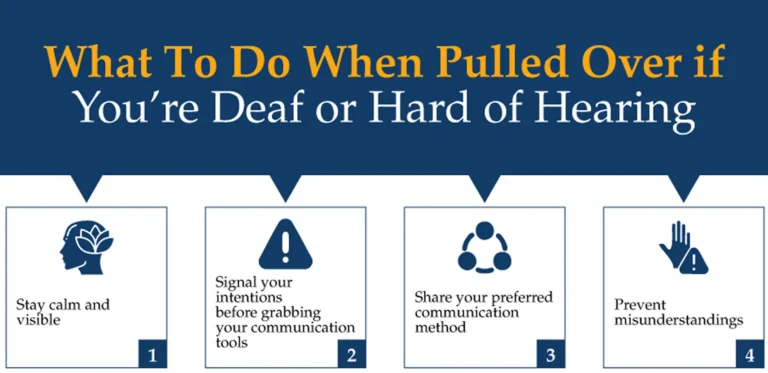
What To Do When Pulled Over if You’re Deaf or Hard of Hearing
If you have a hearing impairment, here’s how you can protect yourself during a roadside encounter with law enforcement:
- Stay calm and visible. Pull over safely as soon as you notice the patrol car’s lights. Remain in the vehicle as the officer approaches and keep your hands visible.
- Signal your intentions before grabbing your communication tools. If you can speak, calmly tell the officer that you’re going to reach for your phone, notepad, or visor card so they can communicate with you. If you’re nonverbal, point toward the item first and wait to see that the officer appears at ease before reaching for it. Then, use your preferred tool to explain that you’re deaf or hard of hearing.
- Share your preferred communication method. Let the officer know how you communicate best, such as by writing, reading lips, or using a transcription app.
- Prevent misunderstandings. If you’re unsure what the officer is saying, don’t nod or respond as if you understand. Instead, politely indicate that you need clarification. This can help you avoid unintentionally giving information that law enforcement could use against you.
Advocacy and Resources for Change
Mobility is a basic human need. It’s essential for accessing employment, education, health care, and other community resources. Inclusive transportation and licensing policies enable people with hearing impairments to fully participate in society, and several national organizations are working to make that inclusion a reality.
The National Association of the Deaf (NAD), the Hearing Loss Association of America (HLAA), and the American Civil Liberties Union (ACLU) advocate for policies that promote equal treatment for individuals who are hard of hearing. Their efforts include improving police training on effective communication, expanding DMV accessibility for testing and licensing, and challenging outdated policies that limit driver eligibility. Together, these initiatives push for greater access to transportation for all drivers, regardless of hearing ability.

Deaf Drivers Have Rights, Options, and Support
Countless people with hearing loss drive safely every day. But accidents can still happen, often because of another driver’s negligence.
Compensation may be available in these situations, but insurance companies may use hearing loss as an excuse to minimize a deaf driver’s personal injury claim. When that happens, you deserve a legal team that understands the unique challenges faced by drivers who are hard of hearing.
Harding Mazzotti is prepared to stand up to unfair blame and pursue the results you deserve. Contact us online or call 844-446-1044 for a free consultation about your rights and options.