
Traffic accidents have been an unfortunate consequence of driving since the invention of the automobile. The first U.S. accident happened in 1891 in Ohio City, Ohio, when John William Lambert’s single-cylinder gasoline automobile hit a tree root, swerved, and hit a hitching post, causing minor injuries.
Today, we are fortunate in many ways as decades of development have yielded new and innovative safety features, such as crumple zones, airbags, and electronic stability control. However, in 2024, there were still an estimated 39,345 people who died in U.S. motor vehicle crashes. Clearly, even with these continual safety improvements, there have been a number of notably severe car accidents over the years.
What Are the Deadliest Traffic Accidents in U.S. History?
A June 1956 accident in Fayetteville, North Carolina, where a modified flatbed truck carrying migrant workers was struck by a tractor-trailer, killing 21 people.
A 1988 Kentucky school bus accident, where a bus full of children was struck by a pickup truck driven by an intoxicated driver, resulting in 27 deaths and 34 injuries, most of them severe. It remains the deadliest bus crash in U.S. history. The drunk driver received a 16-year prison sentence, while the mothers of two of the victims went on to serve as national president and vice president of the advocacy group Mothers Against Drunk Driving (MADD).
Horrific accidents like the Fayetteville truck crash and the Kentucky school bus crash have led to vehicle safety advancements, new laws, and increased drunk driving awareness. Many major U.S. crashes involved multiple vehicles, as we will look at below.
A Timeline of the Worst Multi-Vehicle Pileups in U.S. History
Most major U.S. pileups are caused by sudden weather conditions such as fog, snow squalls, dust storms, or black ice on high-speed interstates.
December 11, 1990
Shortly after 9:00 a.m. on Interstate 75 in Tennessee near Calhoun, a dense fog rolled in and covered the highway. There were warning signs posted, but the conditions had changed so quickly that they were of little help to motorists. A 99-car pileup ensued. The wreckage was spread out over half a mile, and 13 people lost their lives. Vehicle fires, which only worsened visibility problems, led to the dispatch of 33 fire departments.
Tennessee has since installed an improved fog warning system, with fog sensors that can quickly and automatically change the display on highway signs to alert motorists. This system can also close highway on-ramps to prevent pileups, while reflective markers and flashing lights can help guide vehicles already traveling through the fog.
November 29, 1991
Motorists returning home after the Thanksgiving holiday along Interstate 5 in California were engulfed in winds exceeding 40 miles per hour. Due to a severe drought that year, many of the surrounding farmlands had been left unplanted.
The high winds whipped up the dry topsoil and created a dust storm that severely reduced visibility, leading to a series of crashes that became a 104-car pileup stretching over a mile of highway. Rescue efforts continued for many hours, and 17 people died while 150 were seriously injured. Several thousand motorists were trapped in their cars for most of the day as road crews worked to reopen the highway. It remains one of the worst traffic accidents in California history.
February 22, 2000
In Stafford, Virginia, after a series of balmy days, the temperature dropped rapidly, and a sudden snowstorm created whiteout conditions that took motorists by surprise. On Interstate 95, a pileup involving 117 vehicles occurred, the worst in Virginia history. One person died, and 31 more were injured. A remarkable combined response by various state agencies and authorities led to the rescue and recovery of all victims, the clearing of the wreckage, and the reopening of the highway in just 12 hours.
March 14, 2002
At 7:45 a.m., a heavy fog formed on Interstate 75 in Catoosa County, Georgia. A tractor-trailer, unable to see more than a car length ahead, struck another tractor-trailer from behind, sending it over the median and into the southbound lanes. The ensuing accident pileup involved 125 vehicles, closed both directions of traffic, and led to the deaths of four people. Thirty-nine more were injured.
November 3, 2002
The largest multi-car accident in U.S. history occurred on this day, around 25 miles south of Los Angeles, California, on Interstate 10. Although it involved an astounding 216 vehicles, there were no deaths reported. However, 41 people were injured.
The pileup began around 7:00 a.m., when a tractor-trailer struck a concrete divider, but the primary cause of the accident is believed to be a thick fog that formed over the area that morning. Visibility was severely reduced. Two miles of highway had to be closed until late in the afternoon.
November 3, 2007
A 5-year-old boy and a 26-year-old man were killed, and more than 36 others were injured, in a 108-vehicle pileup on Highway 99 near Fresno, California. Dense fog was the precipitating factor in the accident, and more than nine tractor-trailers were involved.
January 6, 2008
Drivers failing to adjust their speeds in thick fog caused two separate accidents on either side of Interstate 90 in Madison, Wisconsin. A vehicle pileup involving 100 vehicles occurred across both sides of the highway. Two people died, and there were over 50 injuries, while thousands were stranded for hours because of the blocked traffic.
January 19, 2009
Snowy, icy roads were to blame for at least 20 vehicle accidents in Washington County, Maryland, on this day. The worst accident involved 7 tractor-trailers and 35 cars, resulting in two deaths and 35 injuries, 12 of which were serious. The American Red Cross was able to take 45 people to one of its shelters until the road conditions improved.
February 14, 2010
A large snowstorm struck Kansas City, Kansas, and caused multiple traffic pileups across the city. However, one pileup on Interstate 70 just before 1:00 p.m. involved 140 vehicles. Although multiple injuries were reported, there were thankfully no deaths.
December 1, 2011
Despite Tennessee’s efforts to improve fog detection and driver notification, the state’s largest multi-vehicle crash occurred on this day, involving 176 vehicles. A combination of fog and black ice during the morning commute was to blame.
Although a school bus full of children was involved, none of the passengers were injured. The only death was that of a male driver whose car slid under a tractor-trailer, but 16 more were treated for mostly neck and back injuries. After a 24-hour cleanup effort, 50 vehicles were still not removed from the roadways.
November 12, 2020
Most recently, nearly 30 vehicles were involved in a pileup along Interstate 94 in Monticello, Minnesota. The crash began at 9:15 a.m. and was likely caused by poor visibility and icy roads. Nine people were hospitalized with minor injuries. Of the 29 vehicles involved, nearly half were tractor-trailers. Cleaning up the oil and wreckage debris lasted until early evening, when the road was finally reopened.
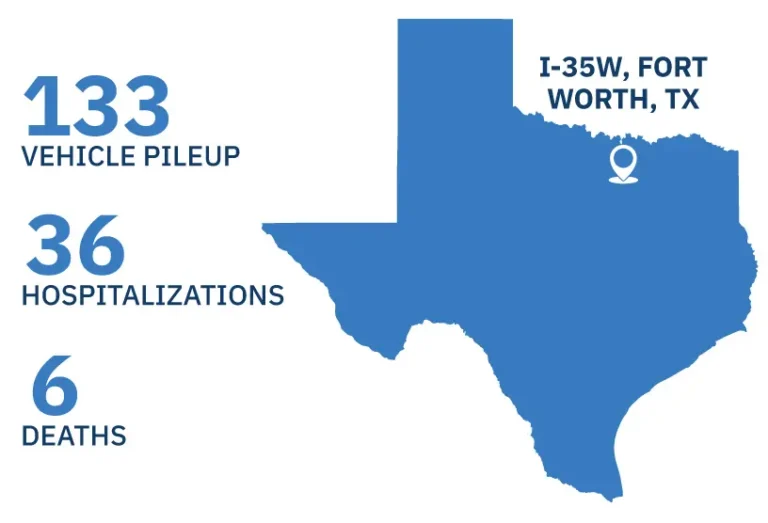
February 11, 2021 — I-35W, Fort Worth, TX
In Fort Worth, Texas, on February 11, 2021, a pre-dawn ice storm caused a 133-vehicle pileup in the southbound managed toll lanes. This resulted in 36 hospitalizations and six deaths, including two pedestrians who had exited their vehicles. The National Transportation Safety Board’s final report for the incident cited inadequate roadway de-icing, insufficient maintenance training, and excessive speeds for conditions.
January 31, 2026 — Highway 99, Tulare County, CA
Dense morning fog on January 31, 2026, in Tulare County, California, led to a 59-vehicle pileup near Earlimart between Bakersfield and Fresno. Multiple injuries were reported, and the incident led to both directions being shut down for hours.
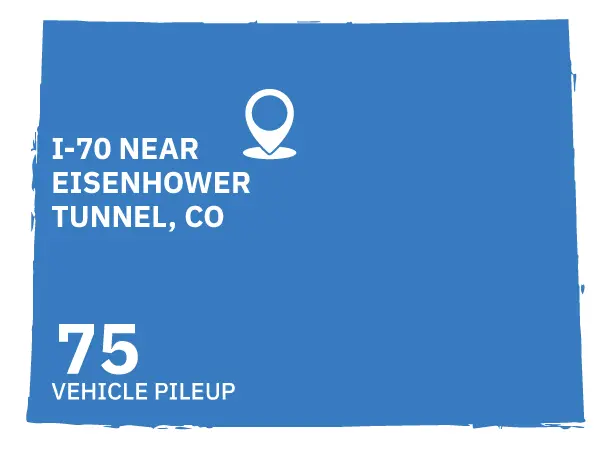
April 14, 2026 — I-70 near Eisenhower Tunnel, CO
When snow covered the I-70 west in Denver on April 14, 2026, this triggered a 75-vehicle pileup near Loveland Ski Area. As a result, both lanes were shut down due to rapidly deteriorating winter conditions, according to CDOT.
What Causes the Worst Multi-Vehicle Pileups in U.S. History?
Clearly, poor weather has played a significant role in pileups throughout U.S. history. As cited in the cases above, sudden fog, dust storms, snow squalls, and black ice can change road conditions, increasing the risk of an accident. In many cases, other factors, such as excessive speed and following too closely, were also found to contribute to these incidents.
How Have History’s Worst Crashes Shaped Modern Vehicle Safety Technology?
While many of the recorded crashes in U.S. history have led to deadly and devastating outcomes, they have also brought greater awareness to flaws in our vehicle technology. This has allowed us to identify risk factors in existing vehicles and to begin developing new technology to improve overall road safety.
Several in-vehicle advancements have been developed to enhance the driver experience, including the following:
- Anti-lock braking: Helps drivers maintain steering control during hard braking by preventing the wheels from locking up.
- Electronic stability control: Detects loss of traction and automatically applies braking or reduces engine power to help keep the vehicle on its intended path.
- Airbags and crumple zones: Work together to absorb crash forces and reduce the risk of serious injury to vehicle occupants.
- Adaptive cruise and lane-keep systems: Assist with maintaining a safe following distance and keeping the vehicle centered within its lane.
- Automatic emergency braking: Monitors for potential collisions and can automatically apply the brakes when a driver does not respond in time.
Roadway-level innovations have also played a crucial role in safety improvements. For example, automated fog-warning systems detect reduced visibility and alert drivers in real time, prompting them to slow down and reducing the risk of fog-related crashes.
Similarly, variable speed limit systems adjust posted speed limits based on traffic, weather, and roadway conditions, improving traffic flow and reducing collision risk during hazardous conditions. Lastly, reflective lane markers enhance lane visibility in darkness, rain, fog, and other low-visibility conditions, helping drivers maintain proper lane position and avoid roadway departures.
What Injuries Are Most Common in History’s Worst Pileups?
Unfortunately, pileups often result in numerous injuries, ranging from minor to severe. Some of the most commonly seen injuries include the following:
- Traumatic brain injuries
- Spinal cord injuries
- Multiple fractures
- Internal organ damage
- Burn injuries
- Soft-tissue or whiplash injuries
How Can You Stay Safe in Conditions That Cause These Pileups?
- Check the weather forecast. Knowing what conditions to expect on your trip or during your commute allows you to adjust your plans before you leave the house.
- Keep your car well-maintained. This means having good tires and windshield wipers, functioning headlights and taillights, and clear windows and mirrors. If your vehicle does not meet these standards, do not take it out when adverse weather is possible.
- Keep cold weather gear in your vehicle. Securely store items in your car, such as food, water, and cold weather gear, in case you are stranded due to bad weather. Make sure your phone is fully charged, or you have a way to recharge it. Also, ensure you have more than enough gas in the tank for your trip, even if it is just to work or school.
- Give yourself extra time and slow down. So many accidents are preventable simply by taking it slow in poor weather conditions. Drive at a slow but consistent speed and avoid hard braking or sudden turning. It is better to arrive late than not at all.
- Do not tailgate. In bad weather conditions, never follow anyone too closely, especially tractor-trailers, which take much longer to stop than a passenger vehicle. If someone is tailgating you, move over and let them pass if you can.
- Stay home. If your trip is not urgent and the weather forecast looks bad, consider delaying it until conditions improve.
- Know that 4WD or AWD is not magic. It takes a car with four-wheel-drive or all-wheel-drive just as long to stop in bad weather as a vehicle without these features.
- Use Your Signals and Change Lanes Slowly. Be obvious and deliberate in all of your movements behind the wheel. Always assume that vehicles near and behind you cannot see that you are changing lanes.
It should also be noted that while some of the large-scale traffic accidents listed above may have resulted in a comparatively low number of deaths, many more people were injured in each instance.
Though data is not available as to the extent of individual injuries, any injury can be potentially life-changing and have long-term consequences from an auto accident. That is why it is always vital to seek immediate medical attention after even a minor accident.
Lastly, it is extremely important to know what to do if you are involved in any vehicle accident (especially a motorcycle accident) so that you can both stay safe at the scene and protect your rights going forward.
What Are the Legal Implications of Being in a Major Pileup Like These?
Accidents involving more than two vehicles can be much more complicated due to several additional complexities. For one, these incidents typically have multiple at-fault parties. Drivers, trucking companies, road-maintenance contractors, and government entities can all share liability, making it more difficult to determine what percentage of fault to assign to each party.
It is important to understand your state’s specific laws regarding accidents, fault determination, and filing deadlines. Comparative-negligence rules govern how shared fault affects recovery, and statutes of limitations vary by state, typically allowing 2 to 3 years to file personal injury claims. A skilled attorney can provide clarity on these laws and how they apply to your specific case.
Contact Our Auto Injury Attorney if You Have Been in a Crash
If you or someone you know has been hurt in any type of car accident, the attorneys at Martin, Harding & Mazzotti, LLP have extensive experience dealing with insurance companies and protecting your right to fair compensation. We have secured numerous favorable case results on behalf of our clients.
Our team handles all sorts of motor vehicle crashes, including cars, motorcycles, and truck accidents ranging from eighteen-wheelers to delivery vans. Reach out today for a free case review by calling 844-446-1044. We are available 24/7 to answer your call, or you can use our easy online contact form.